Monday, May 17, 2010

Things I like

I was recently asked why I like to travel so much.  I don't have a concise answer to this question, but I was able to articulate that traveling gives you a chance to see the positive aspects of a different culture and time to think about your own lifestyle in comparison.  Like any other activity in life, when you see someone doing something a little bit better than you, it's nice to take note and maybe incorporate it into your own life.  Traveling highlights the humbling fact that our behavior and expectations are products of culture. 

Obviously there are deep cultural differences between me and the people in Bolivia.  I understand some of those differences, but not enough to be writing about them.  Instead I have just a few observations of things I like and things I don't like.

Something I like:  In Sucre, I settled into a nice daily rhythm of homework, Spanish class, going to the bar and then to a club until 3 or 4 in the morning.  It was easy to make friends on any given night.  Sucre is one place where I could show up to a club by myself on a Wednesday night and leave with six new friends to the next hot spot.  I don't think this kind of openness really exists back home.  Girls were happy to dance with me, guys were happy to pass me a beer.  I'm sure my "whiteness" had something to do with it, but everyone seemed to have a really friendly vibe.  Going out at home always feels like everyone is clustered with the 4 other people they came with and not interested in talking with anyone else.   

Something I like:  When phone/internet cafes don't have coins small enough to make the correct change, instead of rounding up the bill, they give you a piece of candy.

Something I don't like:  Like any city, Sucre has its fair share of beggars. But for some reason, all the beggars in Sucre seem to be elderly women.  For a city that is generally well off, it was really depressing coming across so many old, homeless women.  I don't understand what happened along the way that they would have no one to take care of them.

From Sucre I took a nice 12hr bus ride back to La Paz and immediately got on a not-so-nice 19hr bus to Rurrenabaque, a town on the edge of the Amazon basin.  Rurre is a small town with a tropical feel and dozens of tour operators that offer jungle excursions. 

Something I like:  I went to Rurrenabaque with Mimi, my couchsurfing friend from Korea.  While walking down the street, Mimi made friends with a 16 year old girl and her mom, who were just sitting outside of their house.  When I came walking down the street and saw them talking, they were really welcoming as well.  Next thing you know, Mimi and I are having dinner with the whole family.  It's a scenario that's hard to imagine back home.  It was also encouraging to see a healthy co-existence between local people and tourists in a town dominated by the tourism industry. 

Jungle pics!!

From Bolivia Pt III


From Bolivia Pt III


From Bolivia Pt III


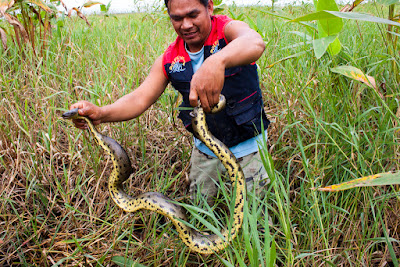
Anaconda Hunting:  Walking around in chest-high grass and 6 inches of water hoping that you're lucky enough to disturb one of these snakes.
From Bolivia Pt III


Something I don't like:  Getting out of Rurrenabaque proved to be more difficult than I imagined.  Road blocks had been set up by protesters, for reasons which are still unclear to me.  After 4 days of no bus service I had to fly back to La Paz in order to catch a bus to Lima, where my flight to Taipei was booked.  The upside to the situation was experiencing Rurrenabaque's airport:  one room, no metal detectors, a grass runway, no service in the rain.  Instead of a harrowing, 19 hr bus ride, the prop plane made the journey in 40 minutes.  My bus to Lima (30 hrs) almost didn't happen because of more road blocks just outside of La Paz.  Our bus driver took matters into his own hands and maneuvered an offroad detour.  I remember looking out the window and thinking....yep, we are in a field right now, and the bus is driving through a stream.  Sweet. 

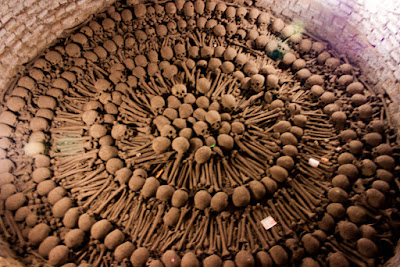
I had a quick two days in Lima and re-visited one of the cathedrals in the historical center.  I had been there in 2001 and took a tour of the catacombs where the bones of some 25,000 people lay resting.  I was really looking forward to properly photographing the catacombs because they had made such an impression on me the first time.  But things change over time, and now photography is prohibited.  Bummer.  I managed to sneak in this blurry shot:
From Lima


My plan to head to the Philippines got slightly sidetracked after I booked my flight and happened to have a layover in Taipei.  I met Emily, a couchsurfer from Taipei, a year ago when she was visiting DC.  After booking my flight, I sent Emily an email to see if she'd be able to meet up.  She suggested changing my flight so I could spend a few days in the city, which I did.  Emily was a great host and her friends and family really went out of their way to make me feel welcome.  So a big "Thank you" to Emily.  I think it something special to be able to share "hometown" experiences with someone from another country.  It's rare to be able to play both host and guest with the same person, so for that I've very grateful.

From Taipei


From Taipei


From Taipei


As is the case whenever I go somewhere new, I left Taipei feeling like I could spend a whole lot more time exploring the city, not to mention the rest of the country. 

It was Emily's friend who asked my why I liked to travel.  Emily asked the obvious follow-up question: What have I learned from Taiwan?  At the moment, I didn't have an answer.  But I've thought of two small things:  While riding the crowded metro, I noticed two people who were quick to give up their seat for someone else who needed it more than them.  There seemed to be a sense of conscientiousness that is different from home. The other example is food.  Don't get me wrong, a lot of Taiwanese food is disgusting. Stinky tofu (that's what Emily calls it) smells like the zoo and tastes even worse.
From Taipei

However, the sheer variety of food and the creative preparation methods are really impressive.  Walking down the street, I was completely overwhelmed by all the different foods available. 

The past few weeks have been a whirlwind.  Now I am in the northern Philippines........more to come.

Wednesday, April 21, 2010

Back to School

At this point, I've traveled in 10 Spanish speaking countries and yet, have managed to squeak by with a barely rudimentary grasp of the language.  In 9th grade, we learned to say, "I like to dance", but beyond that, I don't remember anything.  I've cobbled together some essential conversation skills from the Lonely Planet phrasebook, but unless it's explicitly laid out, I'm pretty clueless.  It was time to put in the effort to form complete, grammatically-correct sentences, all on my own.

Sucre, Bolivia's judicial capital and sight of independence, has become a popular place for learning Spanish.  With a population over 200,000 people, Sucre is a "big" little city.  There are no glass office buildings, only whitewashed colonial architecture.  It's a beautiful city, home to striking churches and museums, a green central plaza, and it's a pleasant place to take classes.  My biggest criticism of the city are the tight streets. Since the preserved city-center was constructed before cars were prevalent, nearly every street is forced to accommodate an unreasonable amount of foot and automobile traffic.  The sidewalk are thin slices of concrete laid down between the street and building fronts.  Oncoming pedestrians force you into the narrow street where cars are unlikely to slow down.  I keep waiting to get clipped in the back of the head by a bus's extended side-mirror.


From Bolivia Pt II


From Bolivia Pt II


From Bolivia Pt II


I've been taking 4 hours of private lessons every day (Mon - Fri) for the past few weeks which brings feeling of a routine.  Most days I have homework, which means I am content to do absolutely nothing for a few hours of the day.  I've made friends with a few travelers who have since come and gone, as well as a few locals I met through couchsurfing.  I also managed to pick up a local girl at the bar, who spoke absolutely no English, which I considered a linguistic victory.  We hung out a few times, and she took me to the movies for my birthday, but I blew off our Saturday night plans and now she wants nothing to do with me.  I guess that's par for the course.

So I had my second consecutive birthday in South America and I'm no longer in my twenties, although people are consistently surprised by my age.  I don't know why, maybe because I still have acne.  After seeing "Alice in Wonderland" in Spanish (it felt wrong to have Johnny Depp dubbed over), I met up with my couchsurfing friends at the bar.  As closing time set in, we moved the party to an after-hours kareoke club, where I sang "La Bamba" and "Let it Be" with a Korean girl.  The memories are unique if nothing else.

From a village near Sucre:

From Bolivia Pt II


From Bolivia Pt II


Kjarkas, the MOST popular Bolivian band was in town last weekend and it was all anyone could talk about.  Tickets were only $5.  They play traditional Andean folk music.  The evening was filled with not only music, but many regional dances, complete with costumes and story lines.  What impressed me about the experience was the multi-generational appeal of the music.  Young teenagers, old grandparents, it didn't matter, everyone loved it.

From Bolivia Pt II


From Bolivia Pt II


I finally found an occasion to use the video feature on my new camera:


Before setting up camp in Sucre, I spend a few days in La Paz, a much bigger city.  I caught the "Good Friday" parade, which was a nice little dose of South American Catholic culture. 

From Bolivia Pt II


The street markets in La Paz are a big dose of color and people.
From Bolivia Pt II


Generally speaking, the indigenous people really do not like to have their picture taken.  I try really hard to be respectful of this, but the temptation to get wonderful pictures is great.  The shots I have of the markets are taken while carrying my camera at waist level, with a wide-angle lens and fast shutter speed.  I click away indescriminately and as inconspicous as possible, and then try to crop down and rotate for an acceptable photo. 
From Bolivia Pt II

The one time I brought my camera up to my eye, I thought I could possibly take a picture without offending anyone.  This is that shot:
From Bolivia Pt II

The woman in the photo immediately covered her face with hat.  I tried to tell her that I was only taking a picture of the bags, and not her - I know, I lied.  I felt really rotten about it afterwords, and even now the photo makes me cringe.  But here it is, for your viewing pleasure.

I also went to the "Coca Museum" which gives quite an interesting history of the coca leaf and paints the U.S. in quite an unfavorable light for transforming the relatively benign experience of chewing coca leaves into a physically, economically, and socially destructive drug.   In the 1500's, the Spanish were quick to brand the coca leaf as a substance of the devil, until they realized that chewing the leaves increased the productivity of the indigenous slaves by staving off hunger and sleep.  The slaves were quickly caught up in a vicious cycle of needing the leaves to fulfill their quota of work, and simultaneously indebted to the Spanish, who controlled the supply of the leaves.

Coca leaves continue to play an important role for manual laborers in Bolivia.  This is especially true for the miners living in Potosi.  For a really sobering look at mining life and really a sobering perspective on life in general -- Get out your pencils -- please please check out the documentary "The Devil's Miner".  It's about a 14 year old boy working in the mines and the culture that surrounds it.  I promise you won't be disappointed.

I've had one stressful moment since being here.  The details are not so important but the general outline of the story involves my bag getting checked on to one bus, and me (accidentally) getting on a completely different bus. Then frantically trying to chase down the right bus in a taxi, which stalled out at a tollbooth.  It's a little embarrassing because while my bag was headed for a city 12 hrs away, I was chatting up some American girls (just out of college), destroying a cork on a bottle of wine with my Leatherman tool, and feeling pretty good about myself.  Everything turned out ok, but it's not a good feeling knowing that all of your earthly possessions are showing up at a bus station without you.

From Bolivia Pt II

Tuesday, April 13, 2010

Change of Plans

Where are you from? How long have you been here?  How long are you traveling?  How far into your travels are you? Where are you headed to? Where did you come from? - These are the questions that come up over and over again when you're staying in low-budget hostals.  It has all the charm of asking someone what they do for a living, but still, this is how valuable travel information gets passed along.  Plus, they are questions that everyone has can answer.

So I was talking to this Dutch guy, and we were running over our travel itineraries.  He seemed genuinely disappointed at how many places I would not be visiting in South America.  Since I don't have a strict travel agenda, I was curious to hear what he thought were good places to visit.  It was quickly clear that he thought I should spend my entire trip in South America.  I told him I would also like to visit Africa and Asia.  He sort of scoffed at the idea of visiting Africa and said that Africa didn't interest him at all.  At that point, I stopped caring about what he had to say.
 
The questions still remain: Where to go and how long to stay?

There is no answer, only hunches formed by small tidbits of information.  A destination "sounds" nice because of a blurb in an article or movie, or because of an offhanded comment overheard at a party.  Doing the research to find out what a place is really like is only going to form expectations and eliminate the possibility of discovering the unexpected, so I try to avoid that.  Also, I'm lazy.


My itinerary in Argentina began to feel stale.  I felt immersed in the culture of the tourism industry and a sea of other travelers, all following the same route, all doing the same things.  So I headed to Boliva to see the salt flats and to take Spanish lessons.  I stopped off in Santiago to get a Bolivian visa and to replace my camera battery charger, which I left wedged between the mattress and the wall at my hostel in El Calafate.  The visa was a 20 min stop at the Bolivian embassy.  The charger ($15 on amazon) took an entire afternoon of shopping and cost $85.

As far as big cities go, Santiago is a really pleasant: relatively clean, friendly people, good metro system, modern retail stores. Just outside the city is one of Chile's largest wine producers, Concha y Toro.  I took a tour of the vineyard, sampled, wine and ate Cabernet Savignion grapes right off the vine.

From Northern Chile


From Northern Chile


The 24 hour bus ride north into the desert of northern Chile was extended by 3 hours due to an ignited oil tanker in the middle of the highway.  It was something right out of the 6 o'clock news.  Fifty-foot flames,blacking billowing smoke, the whole bit.  We sat 100 yards from the accident in the desert's midday heat, watching the tanker's metal frame disintegrate from the intense heat.

I did some hiking in northern Chile before crossing the border to Bolivia.

From Northern Chile


From Northern Chile


From Northern Chile


The Bolivian salt flats and extra-terrestrial mountain landscape has been on my "to-see" list for a long time.  It's an area that is largely uninhabited and resembles nothing familiar to me.  The altitude of the road climbs to 16,000 feet.  A few tough species of grass are the only vegetation.  Minerals and algae create foreign colors in the earth and lakes, sulfur smokes from open geysers.  

The only way to see this region is to go on a guided tour with an outfit that is prepared to driving at high altitudes and on unforgiving terrain.  I was promised that there would be mechanical failures, and there were.  We had three Toyota Land Cruisers, with 5 or 6 people in each car.  Two of our vehicles broke down over the course of the 3 days.  The "roads" we traveled were just 2-tracks in the gravel, or sometimes we were just flying over wide plains of nothingness.

The Bolivian immigration office is the most remote border crossing I've ever done.  It's probably 60 miles from the Chilean immigration office and at an altitude of 15,000 ft.

From Southern Bolivia


My body was not happy with the sudden elevation change.  I've trekked at similar altitudes in India without problems, but also had the chance to acclimatize.  By noon the first day, I was curled up in the back of the Land Cruiser, getting tossed back and forth, and quietly praying for death.  I had the worst stomach ache, my head felt like it was being crushed in a vice, the sun seemed blindingly bright and I was entirely drained of energy.  By evening I was feeling much better, and by the next morning I had just a slight headache.  Most of the other people on the tour had headaches, but I seemed to have it the worst.  I took some beautiful photographs that day, but when I look at them, I'm just reminded of how awful I felt. 

From Southern Bolivia


From Southern Bolivia


From Southern Bolivia


From Southern Bolivia


Accommodations were sparse.  The first night we stayed in a basic concrete shelter equipped with solar panels for electricity.  The second night we stayed in a "salt hotel", where the floor, the walls, the tables, the chairs, are all made out of salt blocks.  It's very strange.  The next day, on the salt flats, we could see how they harvest the blocks.

From Southern Bolivia


From Southern Bolivia


The salt flats in Bolivia are the largest in the world and not surprisingly, really flat.  Over the area of 4,000 sq miles, the elevation changes by less than one meter.  They are used for calibration by NASA's altimeter satellites.  Also, you have a lot of fun with photography because the perspective never changes!

From Southern Bolivia


From Southern Bolivia


From Southern Bolivia


At a village along the way:

From Southern Bolivia


From Southern Bolivia


Check out picasa for more photos.


Also, my knee is still hurting.....but I am getting along ok.