Friday, August 20, 2010

Blue Skies and Mutton

About four years ago I watched a DVD series which followed the actors Ewan McGregor and Charley Boorman on a motorcycle journey from London to New York.  The footage from the Mongolian leg of the trip is what first put into my mind that I wanted to come here.  It's a country of vast open spaces, nomadic culture, and a strong historical legacy.  With a population under 3 million people and a land mass twice the size of Texas, Mongolia is the most sparsely populated country in the world.  About 40% of Mongolia's population lives in the capital city, Ulaanbaatar, and 30% of the population live as nomads, raising livestock and living in gers, traditional tent houses.

From Mongolia pt 1


From Mongolia pt 2

Sandwiched between two superpowers, Russia and China, Mongolia has been shaped by a desire to preserve the Mongol empire, which was founded by Genghis Khan in 1206, and by the power disputes between Russia and China.  Before coming here, I wrongly assumed that Mongolia would be similar to China.  The people look more Chinese than Russian, but culturally, the Russians have had much more influence on the country.  China's millennium-long history of wanting Mongolia's land has led to some very anti-Chinese sentiments, despite the fact that 70% of Mongolia's exported goods are bought by China.  In the 1920's,  Russia offered Mongolia a shot at real independence, but that was followed by more aggression.  In 1937 Russian leadership executed 27,000 citizens (17,000 Buddhist monks) in an attempt to eradicate religious power.

Coming into Ulaanbaatar (UB), the block concrete buildings are reminiscent of any Communist city from the Soviet era, partially because the Mongolian language also uses the Russian Cyrillic alphabet.  Store fronts are comparatively nondescript and the biggest shopping center, the State Department Store, looks like a 7-story office building.  Commercial branding and advertising  is completely understated by western standards.  Once I adjusted, I found it to be a pleasant city. The streets and sidewalks are clean (especially for someone coming from Manila!), car horns are not used excessively and there are plenty of good restaurants and bars to patronize.

Ulaanbaatar is the central hub for any kind of tourism in Mongolia.  Traveling outside the city into the country-side requires extensive planning and pure solo travel is mostly a bad idea.  Roads deteriorate very quickly into meandering tracks of dirt, and road signs are non-existent.  Without a knowledgeable driver, the chances of a breakdown or getting lost is high.  Because the roads are so bad, bus service is limited.  Informally organized shared vans is how most people get from point A to point B.  Locating accommodation can also be difficult.  In smaller towns there are no externally marked hotels or guest-houses.  But there may be accommodation, which is likely to be a single room with 6 mats on the floor and an outdoor pit toilet.  Without a translator, it would be difficult to locate these places.  Traveling with tents is the norm, so that it's possible to just set up camp wherever you happen to be when the sun sets.

From Mongolia pt 1

Mongolians have a long history of nomadic lifestyles and hospitality.  The ger tent is the accommodation of choice for the entire country.  Families can easily break down the tents and transport them with horses when it's time to move on to greener pastures.  Some families will live in ger tents during the summer season, when there is plenty of grass for the livestock, and then live in a city or town through winter.  Since traveling overland can be difficult, there is an understanding that if you stop at a ger, you will be offered whatever they have, which usually includes milk/cheese/yogurt from horses/cows/yaks/camels, depending on where you are and what's available.  Fermented mare's milk is a Mongolian favorite, I personally found it to be undrinkable.


From Mongolia pt 1


Most of guesthouses in UB also double as tour operators, providing vehicle, driver, guide, food and camping equipment.  Travelers are expected to self-organize and then a trip can be planned to suit everyone's needs.  Most tours last between 1 and 2 weeks, but 5 or 6 weeks is also possible.  Nearly all of the travelers I've met are passing through Mongolia on the Trans-Siberian railway, which cuts down from Lake Baikal in Russia into Beijing.  More than one person has given me a quizzical look when I've told them I've flown here from the Philippines.

The first traveler I met at my hostel was David, an American.  He is a semi-professional photographer (www.fotosbydavid.com - worth looking at) and it doesn't take very long to get the impression that he has been everywhere.  Now 49, he has been traveling the world and working odd jobs for the past 20 years, leaving behind a career in finance and letting the worth of his MBA slowly deteriorate.  I mentioned that one of the reasons I wanted to come to Mongolia was because no one comes here.  With a streak of cynicism, he role-played the scenario of me being at party, talking up my adventures: "Yeah, back when I was riding a camel in the Gobi........"
And then someone interjecting, "Oh, you got stuck on that tour too?"

The next few travelers I met: Franco, Harry and Joe, were also characters in their own right, and not the typical 20-something backpacker from Europe.  I spent eight days locked up in van with these guys on a tour to Khovsgol Lake, Mongolia's second largest lake located on the Russian border and southern edge of Siberia.  Franco, Italian born and 49 years old has been living in Japan for the past 10 years where he teaches English, Japanese, Italian, Spanish and also speaks some Russian.  He doesn't know how many countries he as been to, he lost count after 100.  We called him Marco Polo.  Harry, a 47 year old Kiwi had just finished installing power lines in Iraq and was taking his savings to travel the world and find a place to set up a little hostel, probably somewhere in Southeast Asia.  Joe, 38 from Boston, has been on the road for almost a year and has traveled to at least 120 countries at this point in his life.  There was a point where Franco said, "So I was thinking about going to Sulawesi next year, what can you tell me about it?"  And of course Joe had an answer.

I had been a little apprehentious about spending 8 long days in a van with 5 other guys who I had just met, but time passed quickly and with a lot of laughter as we swapped travel stories.  Franco is the only European I know of who has crossed the U.S./Mexican border by floating across the Rio Grande on an inner-tube.  He started the story and I had to interrupt.  "Wait wait wait, you're an Italian citizen right?"
"Yep."
"So.......why wouldn't you just enter the U.S. legally?"

Back in the 80's it was difficult for an Italian without a permanent address to get a visa.  Franco was traveling South/Central America and was getting low on cash.  He had a friend in NYC who could get him a job as a waiter at an Italian restaurant, where he could make good money and then continue his travels.  The only problem was getting to NYC.  So he paid a Mexican guy to float him across the river, had a tense interaction with a police officer when he wandered into town, but eventually got to the airport.


The trip to the lake was not an easy ride.  I spent a lot of energy just hanging on, trying not to get tossed across our Russian minivan. The landscape is beautiful though, just miles and miles of hills and grass.  The first night was stayed near a monastery that was devastated by the Russians back in the 30's.  A small community of monks live there now and I was happy when at dusk they broke out a soccer ball and motioned for me to join them.  Once we got to the lake we had 2 days of horse riding and relaxing.


From Mongolia pt 1


From Mongolia pt 1


From Mongolia pt 1


Another reason for coming to Mongolia is that I would be here for the big national festival, Nadaam, where sporting competitions happen all over the country.  The three events are wrestling, horse racing, and archery.  The biggest events are naturally in UB, but the country-side festivals offer a more intimate look and were more enjoyable to be at.  As part of our tour, we stopped at a few small towns and got to see a mix of the festivities.


From Mongolia pt 1


From Mongolia pt 1


From Mongolia pt 1


From Mongolia pt 1

We stayed the night in one small town which could have been plucked from an old John Wayne western, complete with log cabins and everyone on horseback.  I was wandering around at dusk, taking pictures, when I stumbled upon a small community center with what sounded like church music coming from the inside.  It turned out to be a talent show for the Nadaam celebration.  I was looking a little lost, not sure what to do, when a girl my age saw me and led me in to find a seat.  She was from a bigger city a few hours away and was visiting family.  She spoke some English and invited me to the dance that was to follow.

The dance held in building that resembled a junior-high gymnasium, with pale blue walls and lit with harsh florescent lights.  A guy with an accordion-sounding synthesizer pounded out traditional melodies.  The whole town was in attendance, from 13 year old girls to the crazy old drunk guy who made his rounds pestering everyone.  Between each song, everyone cleared the dance floor and sat on a row of chairs which lined the walls.  The men were then obligated to ask the women for a dance.  Every 3 minutes, for an hour and a half, everyone sat down and then got back up, and then sat down and then got back up.  I was getting a little tired of this, and a little tired of counting the steps in each the dance when my new friend told me that the "free dance" was coming soon.  Once the free dance started, the everyone organized into a giant circle.   Eventually the circle got too big and it broke down into two smaller circles, everyone dancing in place and just looking at each other.  The weirdness of it all was compounded by the contrast between the women, who made quite an effort to get dressed up, and many of the men who looked like they just got down shoveling manure.


From Mongolia pt 1


Franco, Harry, Joe and I had all arrived in Mongolia at roughly the same time, and so we were experiencing the same first impressions of the people and personality of the country.  After 2 days, Harry was ready to leave Mongolia, saying that he had never met such an unfriendly population of people in his entire life.  Even Franco, whose stories exuded a certain optimism, was having trouble coming up with something positive to say.  After being here for 6 weeks, I feel like I can say that Mongolians are friendly, but they're friendly in their own stone-face sort of way.  Mongolians, especially in the country-side, aren't big on greetings and smiles.  For Harry, who has been living in rural Queensland, Australia, it's unthinkable to pass a car on a lone stretch of highway and not give a wave.  In Mongolia, the opposite seems to be true.

On our second day of driving we stopped for lunch in the rain.  Rather than cook outside, we drove to the nearest ger and invited ourselves in.  Lucky for us, the woman living there had been to school in Russia and could speak some English.  She was really great.  A little while later, a few Mongolian men came in and didn't seem to want to acknowledge our existence.  I offered them cigarettes, which they seemed to like.  This scene re-played itself in a number of different ways over the next week.  In retrospect, I think the men were a little shy, and there just isn't a culture of making a big deal about visitors.  It first felt like they were being rude, but of course that wasn't the case.  A few days later, we were staying in a town for the Nadaam festival.  Harry, venturing off on his own, opened the gate of the guest-house just as a guy was passing by on his motorcycle.  The festival was a 20 minute walk away.  The guy on the motorcycle just stopped and nodded for Harry to get on the back, and then drove him the festival, all with an expressionless face.  After that, I told Harry that he had to stop calling Mongolians unfriendly.

I also met a Korean girl, just out of university at one of the guest-houses, who was doing some volunteer teaching in UB.  I asked how things had been going and she said the first few months were really rough because she thought no one liked her.  After adjusting to Mongolian personality she felt better about her experience.  Another culture note is that it's not good to keep saying "thank you", especially for small gestures because it diminishes the worth of the statement.  It makes a certain amount of sense, but you can imagine that it makes for more subdued interactions.

From my guidebook:
The empty steppes have also made hospitality a matter of sheer necessity rather than a social obligation.  It would be difficult for anyone to travel across the steps without the hospitality  that has developed, as each ger  is able to server travelers as a hotel, restaurant, pub and repair shop.  As a result, Mongolians are able to travel rapidly over long distances without the weight of provisions.  This hospitality is readily extended to strangers and usually given without fanfare or expectation of payment; foreigners are often perplexed by the casual welcoming they receive at even the most remote gers.
We arrived back in UB on July 11th, which was both the official first day of Nadaam and the World Cup final.  It was nice to be in the Philippines at the beginning of the World Cup and then catch a few more games in Mongolia.  For two countries that have never had a horse in the race, the people in both countries were fervent fans.  Despite 2:30am kick-off times, people were gathered in outdoor big beer tents equipped with large-screen projection sets and lots of cheering, regardless of who played.  I think being abroad for the World Cup is a special experience.  It's really nice to see something so universally loved.  I was in Kenya during the 2002 World Cup, and the enthusiasm for any African team was religious.  It's hard not to feel good about an event that crosses so many cultures.

As part of the Nadaam festival, there was a big outdoor concert in the city square.  Walking down the street, I chatted up a Mongolian girl, Tsagii, to ask about the festivities.  It turned out that she was a Japanese teacher at one of the language institutes in UB.  We quickly became friends and she was happy to meet me for Nadaam the next day.  Tsagii invited me to teach English at her school and also mentioned she would be visiting some family in her hometown in the Gobi.  I was already thinking of heading in that direction for my next tour.  When I mentioned this to Tsagii, she invited me to join her as an alternative. The chance to get away from an organized tour and visit a little town in the middle of nowhere is exactly the kind of thing I hope for when I travel, so I was very excited at the opportunity. 

Just a quick geography lesson:  The Gobi region refers to most of southern Mongolia and northern China.  It is a desert region, but the iconic sand dunes account for less than 3% of the area, it's mostly hard dirt and rock.

Tsagii's home town, Zunbayaan, is accessible by train, just 13 hrs south of UB.  The route follows the Trans-Siberian Express.  Zunbayaan used to be a prominent military town, but went into a decline after they downsized their presence.  Nowadays, a Chinese company drills and ships oil, but no money is going back into the local economy.  The town is surrounded with hollowed-out, concrete apartment blocks. Through the hot afternoon hours, the town is nothing but a dusty ghost town.  As the sun sets and weather becomes tolerable, people slowly emerge from their homes.  There is not much to do there, but it was nice to get a little glimpse into this community.

We stayed with her aunt and uncle, who live a small, 3 room house.  Her cousins, 2 girls in college, were also home for the summer.  They were incredibly gracious hosts, giving me "the bedroom" while everyone else slept on the floor in the living room.  Tsagii's uncle, Tau, quickly became a little overbearing, as he had the personality of that drunk guy at the bar who wants desperately to be your best friend.  He knew two English words, "James" and "ok". Every 5 minutes he was checking to make sure that everything was "ok" and performing over-dramatic charades to show me how to perform simple tasks such as washing my hands, or to needlessly point to the television if I wished to watch it.  Tsagii was apologetic and maybe blamed a bit of his behavior on his drinking.


The whole of Zunbayaan looks bombed out.  Tsagii's uncle gave me a tour, which included an abandoned oil rig, and an overgrown swimming pool, which he was proud to point out as Mongolia's largest swimming pool, and an abandoned army tank.  Tsagii hasn't lived there since she was a small child and has a good sense of humor about the appearance of the place.  We also visited a ger just outside of town as the camels were coming in for the night.  Tsagii and I took a quick ride around.  Now I can tell everyone I rode a camel in the Gobi, and it wasn't a tour!  


Surrounding the town are a number of historically-significant religious sites because of an influential 19th century Buddhist monk who lived in the area.  The whole family and I spent a day driving around to visit each site.  There is a sacred mountain shrine, where we threw vodka into the wind as an offering.  There is also an "energy center" near a small temple that will give healing energy to anyone who lays on the ground there, and a few small caves where a monk meditated for 108 days straight.   It all sounds more exciting than what is was.  Throughout the day, Tsagii's uncle encouraged me to do shots of vodka with him, which we took from the plastic coin dish that came from the car's console.  I'm not an expert on these matters, but I think when you're doing vodka shots out of used car parts,  it could be a sign that it's time to cut back.


Back in UB I spent a few days teaching English at the institute where Tsagii worked.  They offered me $8/hour, which I think is a pretty respectable wage.  It was more difficult than I anticipated, mostly because I had no curriculum to follow, and the dozen students in each class were at all different levels.  For the first 10 minutes, I asked a lot of questions and got nothing but blank stares in return.  Eventually they warmed up to me and things got easier, but it was a rough start.

I was trying to figure out my next move when I met Baghi, a 27 year old girl, at a nightclub.  She is a former tour guide, currently doing a bit of event organization and promotion.  In the coming week, her friends from Italy, a couple, were coming to Mongolia for a special tour.  Baghi had been their tour guide the year before and they had maintained the friendship.  Now they were coming back and were hiring Baghi unofficially, by paying her way, to visit two remote regions in the north and west of the country.  The first planned leg of the tour was to the corner of western Mongolia, high in the mountains, where the population is mostly Kazakh (the Kazakhstan border is 24 miles from Mongolia).

I had already read about the region, and was intrigued, but had not met any other travelers venturing off in that direction.  Going there alone would have been cost prohibitive for me.  Baghi invited me to join them and help me arrange my flight and the necessary border permit.  For reasons that aren't important, I wasn't able to join Baghi's tour, but was able to fly out with them and to join an Austrian guy on a similiar tour.

Arriving in Olgii, the primary city in the region is a little surreal.  This is the guidebook's intro:
Traveling to Mongolia's western most province gives one the distince feeling of reaching the end of the road, if not the end of the earth. High, dry, rugged and raw, the isolated, oddly shaped province follows the arc of the Mongol Altai Nuruu as it rolls out of Central Asia towards the barren wastes of the Dzungarian Basin.

From Mongolia pt 2


We spent our days driving, camping, and visiting gers.  Sleeping at an elevation of 8000 ft, the temperature dropped to about 25 degrees the first night.  I kept thinking about how this was August, the hottest month of the year, and there was ice on the tent.  People live in the ger camps only in the summer, letting their yaks and goats graze while they can, and then move down to lower elevations in the winter.  It's a hard life to live. Every ger could offer us the same basic food:  yak-milk tea, yak cheese, yak yogurt, dried biscuits, and sometimes dried meat.  It gets old quick.  Our own food also got old pretty quickly.  We had some variation of  boiled potatoes, carrots, cabbage, rice and fried bits of fatty mutton 3 times a day.  Back on my first tour to the lake, we were complaining about the food and made up joke:
Q: What does Mongolian food taste like?
A: Whatever supermarket-brand bbq sauce you've drowned it in.

Whatever.  It was funny at the time.


From Mongolia pt 2


From Mongolia pt 2


From Mongolia pt 2


I spent a few days hanging out in with Baghi in UB and she did a good job of explaining some of Mongolia's history and culture to me.  With such a long history, and such a small population, Mongolia has been fighting to preserve it's existence for a long time.  There is an aspect in the mindset of Mongolians that distrusts foreigners, especially when it comes to preserving Mongol blood.  At one point, the Chinese tried to breed out the Mongol race.  Now it's taboo for Mongolian women to date Chinese men, and those that do risk having their heads shaved as a type of scarlet letter.  I experienced a little of this animosity myself.  Just walking down the street with Baghi or Tsagii elicited some very unfriendly stares.

Baghi's older sister married a Korean man, which the family is ok with.  However, her sister is not allowed, by order of the family, to raise her son in Mongolia.  When the son is 10 years old, he can come live in Mongolia.  The reason for this is so that her son will never be mistaken as a pure Mongolian.  Learning the language so late in life will guarantee that he talks with a Korean accent, which will effectively bar him from a career in politics.  Last year, when the son was 5 years old, her sister requested to move back to Mongolia, but the family decided that she had to wait another 5 years.  Baghi insists that family relations are good, and she has been to Korea to visit her sister.  It's the responsibility of each Mongolian to protect the blood.

I also heard another story, from a German guy who has been living in UB for the past year.  His friend (also white) was dating a Mongolian girl.  One night they were walking down the street and someone spit at her feet and said something about polluting the blood.

For the most part, walking around UB was a pleasant experience for me and as far as I know, seriously violent crime is not a big problem.  But Mongolian guys seem to be really aggressive.  One night I was walking around and another guy, with friends, abruptly stepped in front of me and stared me down, like he was just waiting for an excuse to start a fight.  On another night, 3 guys were walking towards me and out of nowhere one took a full swing at my face but pulled the punch at the last second.

There aren't really official taxi's in UB.  Any car is potentially a taxi and if you stand on the side of the road with your hand out, someone will stop.  There is an understanding that it's about $1/mile.  One night I took a taxi home at 3am and got into an argument with the driver about how much the fare was.  In my mind we had agreed on a price before I got in.  He basically tried to keep my from opening the door, and when I finally got out, he started pushing me against the car.  I should mention that like most men in Mongolia, he was also a lot bigger than me.

I have some big news to share as well.... I got married!!!  Here is our wedding photo:


Unfortunately, my new wife has to stay in Mongolia to take care of the yaks....They don't milk themselves you know.


From Mongolia pt 2

Wednesday, July 14, 2010

More Island Life

I spent five more quick weeks in the Philippines.  Many of my days I spent wandering around by myself, but nearly every night I went out and found people to talk to.  I traveled a good mix of small islands, big cities and rural country.  No single place was exceptionally noteworthy, but I always found someone or something that kept my interest. 

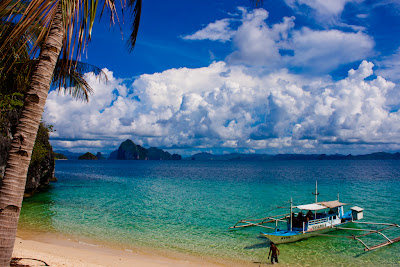
Of the major Filipino islands, Palawan is the least developed.  Roads become unmanageable during the rainy season, ATMs exist in only one city, and electricity is rationed in smaller towns.  While access to the island is not difficult, it is time consuming, which limits the number of visiting tourists.  The primary attraction of Palawan is an archipelago of limestone-cliff islands set in vividly clear, blue water.   I spent about a week here, island hopping and relaxing.


From Philippines - part 2


From Philippines - part 2


From Philippines - part 2


The snorkeling here is top-notch, made even better by the surreal color and clarity of the water.  Every now and then, life gives you a really unexpected moment of wonder.   Near a rocky outcropping, a massive school of mackerel were taking shelter from the open sea.  Millions of fish, changing direction in unison, swam in figure-eight patterns around the underwater rock columns.  I swam into the middle of the school and was completely surrounded by a wall of fish on all sides.   Motionless, I floated just below the surface of the water, watching flashes of silver dart back and forth, feeling really lucky.

My friend took this picture, which sort of captures the moment: 


At first glance, El Nido, the small town used as a base for island hopping, is nothing special to look at.  It's lined with modest, beach-front restaurants and the entire town is small enough to be covered by foot in 15 minutes.  The people of El Nido gave it a certain charm.  While walking down the street, everyone made eye contact with me and smiled.  I rented a motorbike without the need to hand over my passport or a credit card.  The guy at the rental shop explained that it was a small place and if anything happened, he'd find me.  Riding into the unpaved country-side, I was greeted enthusiastically by every child who happened to be out playing in the yard or walking down the street.  It was hard to be comfortable in the midday heat and I got hit with a craving for ice cream.  After poking my head into a few store fronts I stupidly realized that of course there was no ice cream, the electricity is cut every day from 6am - 2pm.

I met Mel, an outgoing 24 year old, waiting tables at a beachfront restaurant and was immediately impressed with his knowledge of world geography and American politics.  We started talking about travel and he quickly listed off a number of places he'd like to go.  His confidence had led me to believe that he had already done some traveling, and was thus a little shocked when I learned that he had never even left the island.  I had a hard time believing that being as smart as we was, he couldn't manage to find a way to leave.  El Nido is the type of place where it would be easy to ignore the rest of the world, but he's constantly keeping up on current events and and spends his free time taking the vocab quizzes in Reader's Digest.  Not satisfied with his degree in finance, he was looking for a way to continue schooling.  I felt really bad for him, ambitious but stuck.  After the restaurant closed, we sat on the beach with his friends and drank beer.

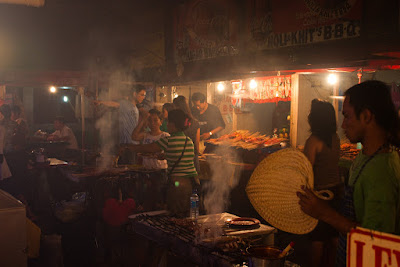
With a population just shy of a million, Cebu City is described by my guidebook as an entree-sized version of Manila: noisy, crowded and dirty.  The guidebook authors recommend against spending your vacation here.  All this is true, but it's not fair to trash the city without mentioning the incredible BBQ found in the city center.  There is a huge tent area, filled with dozens of vendors offering cheap, tasty bbq.  The meat is raw and skewered, you pick what you want and it's grilled for you on demand.  The collective smoke from each bbq is trapped under the giant tent, which has almost no ventilation, and it smells wonderful.


From Philippines - part 2


I had a reunion with Rowelyn, the girl who gave me a ride from the airport to my hotel on my first day in the Phillipines.  She had been living in Taiwan for 3 years as a caretaker for elderly people.  Her next gig is in Fort Nelson, British Columbia.  It's not possible for her to make a decent wage in the Philippines, so she must work abroad.  I had assumed that Fort Nelson was a suburb of Vancouver, but I looked it up and it's a town of 5,000 on the same latitude as Anchorage.  A little worried for her, I asked if she knew exactly where Fort Nelson was.   She had not bothered to look it up!  I suggested that she do a little research, because come this January, she is going to be in a world of hurt.  One night the weather dropped to a frigid 80 degrees and everyone was wearing jackets.  She doesn't even know what minus 20 feels like.  Her obligation is technically 2 years, but her friends in Toronto have promised a transfer after only a few months.  I can't wait to see how this turns out. 

The Philippines face a problem common to many third-world countries, which is that the most educated tend to work and live abroad.  I just read that the United States receives more nurses from the Philippines than any other country.  I met several nursing students in Cebu, all of whom were planning on working abroad.  Staying home just doesn't seem to be an option.  One girl, who was shy, short and really petite, was just finishing up her nursing degree and said that I was the first American she had ever talked to.  She said Americans frightened her because American people are so big, which made me laugh.  She is apprehensive about working in the U.S. because she heard Americans don't like immigrants.  I wasn't sure what to say.  On one hand, I can't imagine anyone being mean to this girl, on the other hand, I couldn't promise her that she won't face any discrimination.  Not long after meeting her, I read an article about several Filipina nurses being fired from a Baltimore hospital for speaking Tagalog during their lunch break.  Maybe she should be apprehensive about Americans.

I met Jill, a Couchsurfing Filipina who owns her own coffee shop and hosts Couchsurfing get-togethers.  There I met a few other Filipinos, a French guy, a German girl and two Dutch guys.  After a night of hanging out at the coffee shop, the 7 of us took a weekend trip to a nearby island.  We stayed out on the beach all night and watched the sun rise.
   
The French guy (29 yrs old) is on a "travel-around-the-world" trip similar to my own.  He spent his first three months volunteering in Mali, which I was very interested to hear about.  He had a classic storyof signing up for one thing and getting thrown into something completely different.  Working without any other western counterparts, he secured quite of bit of funding on infrastructure projects.  His contribution was significant enough that his village gave him a piece of land to call his own.  So if nothing else works out for him, he will always be a land-owner in Mali, so he has that going for him, which is nice.

The two Dutch guys are both living in the Philippines for a one-year volunteer program with a Catholic organization.  One teaches high school for underprivileged kids and the other works in an orphanage for boys.  I asked if they were surprised by any aspect of the work they're doing.  Garbage was their the answer.  Filipinos definitely have a littering problem.  It is really frustrating for them to see the adults of the organization just throwing trash out the window and letting it pile up outside.  Filipino cities are full of litter, a problem that all classes of people seem to contribute to.  I read that because of the country's long history of colonization and war, and disdain for a corrupt government, Filipinos lack a sense of ownership on public space.  It seems to me to be a strange and unfortunate mentality.

Of course there are exceptions, but generally speaking, the cities here are completely lacking aesthetically.  Broken and dirty concrete covers the streets and buildings.  Grass is almost non-existent and sidewalks are poorly laid out.  My hunch is that all this has contributed to the success of the shopping mall here.  Shopping malls are incredibly successful, sometimes with their own mega-courtyards for outdoor shopping.  For cities that have grown up without any city planning, the mall is refreshingly clean and organized.

Back in the city I met Kim, attractive with a combative personality, at one of the trendy night spots.  Her friends showered me with attention, which made me a little suspicious given my daily run-ins with sex workers.  But I saw them out again the next night and they were equally friendly without any hint that they were trying to drum up business.  As we made small talk, I mentioned the hostel where I was staying.  At $7 per night, it was probably the cheapest place in the city.  I made a comment about how it was pretty bare-bones accommodation.  Kim's responded by saying that I probably didn't understand how poor she was and that the place I was staying was much nicer than where she lived.  This surprised me, as I definitely hadn't pegged her as being desperately poor.

Fast-forward a few days:  While hanging out with Jill and our crew of couchsurfers on our weekend get-a-way, I got a text message from Kim saying that if I came back to the city, her landlord had an extra room for $30/month.  To put things into perspective, a decent hotel room starts around $15/night, so $30/month is really, really cheap, even by Filipino standards.  I texted back and said that I would probably just get a hotel room.  She was oddly persistent that I should stay there.

At this point I should say something about my travel philosophy, which is to try to never say no to an opportunity.  This has mostly worked out for the best, although it sometimes lands me in uncomfortable situations.  Riding the bus back to the city, I was curious to see where Kim lived, if she was as poor as she said she was.  When I got my hotel at 10:30pm, they were all booked up.  With this news, I figured I might as well go and see what Kim was trying to sell.

The taxi dropped me off at the designated street corner, in a not-so-nice neighborhood.  I stood there with my backpack on, trying to figure out where to go.  A young couple came up to me, looking really concerned that I was standing there, and asked me where I was going.  "Uh....just looking for my friend."  Then they asked where I was staying.  "Um, hopefully with my friend."  They asked what I would do if I couldn't find my friend.  "Yeah, I don't know."   I eventually found her and her house.  She was renting a room from her friend's family.  The downstairs was damp concrete and cinder block, the walls crawling with cockroaches.  Off the main room was a single water spigot, used for all kitchen and bathroom needs.  Upstairs the walls and bedrooms where single sheets of plywood.  Kim's room, which would become my room, was just big enough to have a twin-size wooden platform as a bed, with no mattress or pad.  There was no ventilation and the air was stifling hot.  Within two minutes of arriving, Kim was insisting that I fix her laptop, which wouldn't boot. 

I carry a portable version of Linux on a USB drive, which is ideal for troubleshooting computers.  As I sat there on the wooden bed, sweat pouring off my body, I had to look around and laugh.  It was definitely not a situation I could have ever imagined being in.  After determining that her hard drive had unfortunately died, I asked if I could take a shower.  Kim and her friend led me back downstairs to the spigot, where I filled a bucket of water.  I was a little confused, because I was essentially standing in a hallway, and there was no door to close me off from the main room.  Her friend looked at me and said I should just turn off the light.  Ok.

Still trying to figure out the bedroom situation, I asked Kim what the deal was.  Since she originally told me that there was an extra room for rent, but clearly I was taking over her room.  She said she would just sleep downstairs with her friend.  The next morning I packed my stuff up and said I was just going to get a hotel room.  She seemed disappointed.  I couldn't really see a reason for my staying there, just to save a few dollars.  I said goodbye and jumped in a taxi.  Later that day I got a text from Kim asking for a HUGE favor, she needed to borrow some money.  How much money, I asked.  Big surprise, she needed $30, the exact amount she was going to rent her room to me.

Now things were starting to make sense.  She promised to pay me back within two days, and that it was really important that she get the money.  Of course this raises all sorts of questions, none of which have convincing answers.

Kim had gotten married when she was 21 to an English guy.  After 7 months she discovered he was cheating on her.  Her heart broken, she divorced him.  She had been in a string of relationships with other Europeans, always ending the same way.  Her last serious boyfriend was a German guy who was "separated" from his wife, but not really.  Kim didn't have a job, but received some sort of regular alimony payment from her ex-husband. She was living with her friend because she wasn't getting along with her dad, but wouldn't tell me exactly why.

The money she needed was to get her identification papers in order so that she could get a job at a call center.  Call centers (mostly for banks and credit cards) are a coveted job for unskilled Filipinos.  I heard this from other people as well.  I told Kim that I wasn't comfortable lending her money but I would still like to be friends with her.  The next day she sent me another text saying that if I could lend her $16 dollars, it would really help her out.  I'm not so naive that I believed I could lend her money and get paid back.  But for $16 dollars, I could fund a little drama, see how it played out, and maybe, just maybe, help Kim get a job.  I was pretty well convinced that she had absolutely no money and was waiting for her alimony to arrive.  She promised to pay me back just as soon as she could.  The upside is that she got her job at the call center.  After two days of hearing that she was still waiting for her money, I stopped asking.

Getting the chance to scratch beneath the surface of Kim's life was interesting for me.  Her life is a little bit of a mess, but I have hope for her.  It's was interesting to because in many ways her story is not unique.  I met a 20 yr old girl on the street.  Not a prostitute, just someone who wanted to talk.  She told me she was leaving in a few weeks to visit her friend in Thailand, where she was going to work.  It turned out that her "friend" was a 60 yr old American guy, who needed someone to help "care" for him.  She had been chatting with him online for two years and now he was paying to have to come to Thailand for 3 months.  There are a number of troubling questions about this situation, and she was understandably nervous about going.  She was a bright and articulate girl, and still, she saw Thailand as her best option for making some money.  On another occasion,  I met a young, nice-looking prostitute outside of a night club who offered to go home with me.  After I declined her offer, she was more persistent and said that she didn't need any money, just some food to eat.  I told I didn't have any food at home.  Really desperate just to get some food, she offered to cook for me.  Those kind of conversations never make you feel good. 

Other run-ins with prostitutes were more light-hearted.  At one bar I had a number of different girls come sit next to me and asked if I could buy them a drink.  I think it's a quick, polite way to find out if you're interested in doing business with them.  One girl sat down and asked me if I like "short time".  This kind of broken English is common in Vietnam or Thailand, but not in the Philippines.  I wasn't sure if I heard her correctly and asked her to repeat herself.  "Do I like short time?" I replied back.  "What's short time?"
"Boom boom short time."
"Ah, boom boom short time......no thanks."

Filipina girls are somewhat plagued by social-economic problems that lead to all these situations.  But one thing I kept hearing over and over again was that they didn't like Filipino guys.  So many of them are looking for a Western guy.  At one restaurant, I made friends with the waitress and bartender.  We went out after their shift and one of the girls, who was around 25 yrs old had just married a German guy who was 60.  They had their first child together and were building a new house.  She could not be happier about her situation.  My impression is that Filipino guys have a reputation for not treating their women very well, and the Western influence and affluence is just more attractive to Filipinas, who don't seemed to be concerned about age gaps.  I guess it's a win-win situation. 

On from Cebu City I bounced around to a few smaller cities, rented motorbikes, and explored the country side.  One afternoon I was passing through a forested area outside a small town and came upon an open-air arena filled with people, betting on the cock fights.  I've never been to anything quite like it, so the the novelty factor was high.  The fights only last a few minutes and it's rare that an injured bird will make a come-back.  The appeal is lost on me, but those are the kinds of random things that you hope to find when you just pick a direction and ride.


From Philippines - part 2


From Philippines - part 2


On another day I was out riding around in a very rural area and stopped at a roadside bbq stand.  The only other people there was a group of older guys who quickly invited me to sit with them.  I ended up eating and drinking with them for a few hours, sharing stories and answering questions about our lives.  One guy, an ex-policeman, was convinced that I was trained military or intelligence because I was out there, traveling alone, and feeling completely at home.  Really funny stuff. 


From Philippines - part 2


From Philippines - part 2


I spent my last days in the Philippines back in Boracay, the ultra-tourist beach town.  Geographically, it was on the way back to Manila, but also I wanted to take it easy for a few days before heading to Mongolia, my next destination.  I arrived in Ulaanbaaatar, Mongolia's capital city, on July 1st.  It's definitely another place all together. 

more shameless sunset pics:

From Philippines - part 2


From Philippines - part 2

Friday, June 4, 2010

A Little Bit of Everything

My immigration officer, a girl around my age, was excited because we share the same birthday.  It was the first time an immigration officer had ever made small with me that didn't feel like an interrogation.  I waited in baggage claim and talked to the girl who had sat next to me on the plane.  She insisted on giving me a ride to my hotel, saving me cab fare.  It was a good entrance into the Philippines.

Manila was essentially destroyed in World War II and sporadically rebuilt resulting in a collection of 17 smaller cities that were not unified until 1976.  Charming is not a word usually ascribed to Manila.  Excluding the commercial district, which is quite modern and clean, the rest of the city are blocks of ugly concrete with garbage strewn everywhere.  If there is one redeeming quality about the city, it's the music.  Filipinos love music.  Live bands are everywhere, and while most of time they are covering American pop and rock music, they are doing it better than the bar bands back home. 

Manila is also full of prostitutes.....lots and lots of prostitutes.  In addition to the girls who are either walking the street or working at one of the many "girlie bars", there is a surprisingly large number of completely innocuous women also looking to make a buck.  An attractive woman wearing jeans and a t-shirt, walking out of the grocery store, stopped to ask me if I wanted a massage.  In the less savory neighborhood where I spent my first night, I couldn't walked two blocks without a girl approaching me.  In attempting to get away from the chaos (and stay out of trouble!), I went into Manila's nicer  commercial district.  The string of restaurants there had a decor to match the trendiest places in NYC or Vegas.  I walked into a Cuban restaurant to check out the live salsa band. The only open seat at the bar was next to a group of four, well-dressed women.  I made friends with them and spent the next 3 hours hanging out.  At the end of the night, the girl who I spent the most time with told me she was a "working girl" and suggested I take her home........and that was just my first night.

Arriving not a moment too soon, Sabrina took a few weeks off of work to come meet me and visit her high-school friend who has been working at an international school in Manila for the past four years.  We stayed with her and Adam, her British fiance, for a few nights.  It was nice to get a few cultural notes from them.  I was asking Adam about his cultural integration and the challenges he faces.  Unfortunately, even after 5 years of living in Manila there is still an expected divide between "the rich white people" and everyone else.  He summed it up for me with this story:  He left something at the front desk of his condo building for his Filipino friend to pick up.  When he tried to explain to the desk clerk who would be picking it up, he was met with the question, "Is he your friend, or is he Filipino?", as if the two were mutually exclusive.  His close friends are other white teachers at the international school, a fact that seems inevitable.

From Manila, Sabrina and I went into the mountainous north to see the rice terraces.  A guide took on a three-day hike to several villages only accessible by foot.  Sabrina had a lot of "firsts" on this trip.  First time hiking for more than a few hours (it was a hard 7-hour hike the first day).  First time showering with only a bucket of water.  First time using a bucket to flush the toilet.  All important things.  We were welcomed our first night by concert put on by the village children.  About 20 kids sang 20 minutes worth of English songs.  The only other tourists staying with us were a few French guys.  When it was suggested that they entertain us with their own song, they picked the obvious Frere Jacques, at which point the children enthusiastically joined in.  So much for teaching them a new song.

Rural village life comes with a few inconveniences.  For Sabrina, the biggest one is living next to the roosters, who start their wake-up call around 3am.  To put a point on this, Sabrina suggested we make a list of animals she likes:  Pandas, penguins, puppies, turtles and fish.  And then she made a list of animals she doesn't like:  Roosters.

The terraces were beautiful and require an unfathomable amount of work to maintain.

From Philippines - part 1


From Philippines - part 1


From Philippines - part 1


Further up into the mountains is another town which is famous for it's hanging coffins. These coffins have been hung on the side of a cliff face (no easy feat) because of the belief that the soul does not like be buried underground, but wants to be free.  Nearby, stacked in the mouth of a cave, are several hundred coffins which are there for same reason. 
From Philippines - part 1


We took a guided cave tour, which was a big thrill for me.  I've been in a lot of caves, but this one is the winner.  No electricity has been piped into it, so the only light is from the guide's gas lantern.  After slowly descending a few hundred feet over guano-covered rocks, the cave turns into a beautiful array of tiered pools, which cascade even further down, ending in a big waterfall and deep swimming hole.

From Philippines - part 1


Heading back towards Manila, we stopped in another big city, Baguio, which was also destroyed in the war.  Outside the city is more beautiful, mountain scenery, but if the city itself possesses any charms, they are well hidden.  To finish out Sabrina's leg of the trip, we went to Boracay, the Philippines most touristy beach town.  Boracay is a small island with a mile-long stretch of fine, white, powdery sand.  It has all the fixings of a fun, vacation destination.  We took a snorkeling trip that was a little mediocre until we saw a large, black and silver-banded sea snake.  Definitely one of the coolest things I've seen underwater.  I followed it around for 5 minutes or so until it went too deep.  The sea snake venom is deadly, but thankfully they are quite timid and their teeth are so small, they have a hard time releasing venom into humans.

From Philippines - part 1


From Philippines - part 1


I usually don't love ultra-touristy destinations, but we found a grungy bar at the end of the beach that was the local hangout, and for me, that was the place to be.  I couldn't go in there without making friends, which is a nice sign that the balance between the transient tourist and the local economy is still on the right side.
From Philippines - part 1


And now, shameless sunset pictures:
From Philippines - part 1


From Philippines - part 1


From Philippines - part 1


From Philippines - part 1